Optibase vs. Convert

Optibase vs Convert: A/B Testing platform comparison

Optibase and Convert are serious A/B testing platforms positioned below enterprise pricing. But they serve different teams. Optibase is built for marketing teams on Webflow with built-in heatmaps and visual analytics. Convert is built for developer-led growth teams that need full-stack testing and statistical depth. Here's how they compare on features, pricing, and fit.
Optibase alternatives

Side-by-side snapshot

Starting price
Free plan
Primary audience
Native Webflow app
Heatmaps & recordings
Full-stack (server-side)
Statistical engine
$69/mo (Free tier available)
Yes (10K tested users)
Marketing teams, Webflow users
Yes
Included
Server-side conversions
Bayesian (P2BB)
$399/mo
No (free trial only)
Developer-led growth teams
No
Not included
Full-stack (client + server SDKs)
Frequentist + Bayesian + Sequential
Optibase alternatives

Feature comparison table

A/B testing
Split URL testing
Multivariate testing
Personalization
Visual editor
Code editor
Heatmaps
Session recordings
Scroll maps
AI traffic allocation
Feature flags
Full-stack SDKs
Native Webflow app
WordPress plugin
GA4 integration
Anti-flicker
Bayesian stats
Sequential testing
Audience segmentation
GDPR compliant
Free plan
(not in entry plan)
(SmartInsert)
(40+ filters)
(HIPAA too)
Detailed comparison

Where Optibase and Convert differ

Optibase and Convert sit in the same "mid-market, not-enterprise-priced" tier of A/B testing — but they're designed for different buyers.

Pricing — $69/mo vs $399/mo

Optibase starts at $69/mo with a free tier for getting started. Convert starts at $399/mo with no free plan (only a free trial).

For marketing teams running client-side website experiments, Optibase delivers A/B testing, split URL testing, multivariate testing, personalization, heatmaps, and session recordings at a fraction of Convert's price.

Convert's higher price reflects its full-stack capabilities — server-side SDKs, feature flags, REST APIs, and advanced statistical engines. If your team needs those developer-oriented features, the price premium may be justified. If you're testing website content and layout, you're paying for capabilities you won't use.
Fast performance icon

Webflow integration

Optibase: Native Webflow Designer app. Install from the App Marketplace, create experiments directly in the Webflow Designer, zero friction.

Convert: No native Webflow integration. Requires manual script injection via custom code or Google Tag Manager. Works, but requires more setup and isn't maintained as a first-class integration.

For Webflow teams, this is a decisive difference. Optibase is the only A/B testing tool built around the Webflow workflow.
Conversion tracking icon

Behavioral analytics

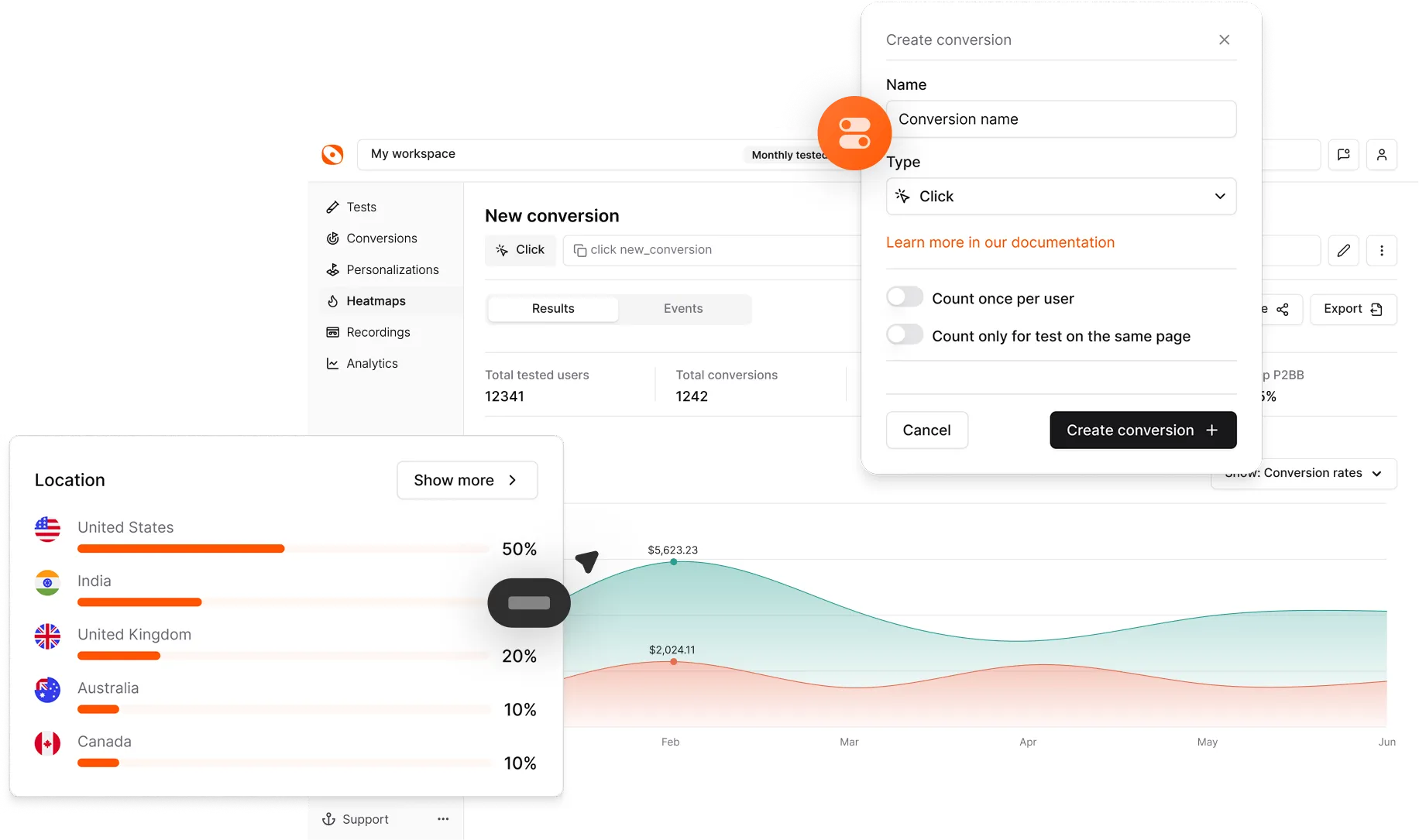
Optibase includes heatmaps, scroll maps, and session recordings in the platform. See where users click, how far they scroll, and replay full sessions alongside your experiment data. No additional tools needed.

Convert does not include behavioral analytics. You'd need to add Hotjar, Clarity, or a similar tool separately — adding another subscription and fragmenting your optimization data.

Full-stack testing & developer features

This is where Convert stands out. Convert offers full-stack experimentation with server-side SDKs (JavaScript, Python, PHP, and more), feature flags, kill switches, REST APIs, and CI/CD integration. It's built for engineering teams running experiments in code.

Optibase focuses on client-side website testing with server-side conversion tracking. It's built for marketing teams running experiments through a visual editor without needing developer involvement.
Analytics chart icon

Statistical approach

Optibase uses a Bayesian engine (P2BB — Probability to Be Best) with auto-stop when a winner is detected. Simple, clear, and designed for marketers who need a reliable answer without configuring stats parameters.

Convert offers both Frequentist and Bayesian engines plus sequential testing (Asymptotic Confidence Sequences). More options for teams with statistical expertise, but more configuration required.
Summary

When to choose each tool

When to use Optibase

You use Webflow. Native integration makes setup instant and experiments easy to manage.
Your team is marketing-led. Visual editor, no-code setup, clear stats — built for marketers running experiments independently.
You want heatmaps included. No need for a separate analytics subscription.
Budget matters. $69/mo vs $399/mo — and Optibase includes behavioral analytics that Convert doesn't.
You want to start free. Optibase has a free tier. Convert doesn't.

When to choose Convert

Your team is developer-led. Server-side SDKs, APIs, feature flags, and CI/CD integration are built for engineering workflows.
You need full-stack experimentation. Testing backend logic, pricing algorithms, or APIs — not just front-end content.
You need advanced statistical control. Multiple stats engines and sequential testing for teams with data science resources.
You're HIPAA-regulated. Convert is HIPAA compliant in addition to GDPR.
FAQ

Frequently asked questions

 Is Optibase cheaper than Convert?
Yes. Optibase starts at $69/mo with a free plan available. Convert starts at $399/mo with no free tier. Optibase also includes heatmaps and session recordings at no extra cost.
 Can Convert integrate with Webflow?
Convert works with Webflow via script injection, but there's no native Webflow Designer app. Setup requires manual code insertion. Optibase is the only A/B testing tool with a native Webflow integration.
Does Convert include heatmaps?
No. Convert focuses on experimentation and does not include behavioral analytics. You'd need a separate tool like Hotjar or Clarity for heatmaps and session recordings. Optibase includes all of these in the platform.
Which is better for a marketing team?
Optibase. It's designed for marketers to run experiments independently — visual editor, no-code setup, heatmaps, and clear Bayesian statistics. Convert is designed for developer-led teams that work with code and APIs.
Does Convert offer feature flags?
Yes. Convert includes feature flags, kill switches, and progressive rollouts as part of its full-stack experimentation platform. Optibase focuses on website experimentation and does not include feature flags.