Learn how to introduce structured A/B testing into your marketing workflow. From hypothesis creation to statistical validation — everything you need to move from ideas to confident decisions.
Run tests with confidence: Know when results are valid.
Avoid costly testing mistakes: Test what matters. Ignore noise.
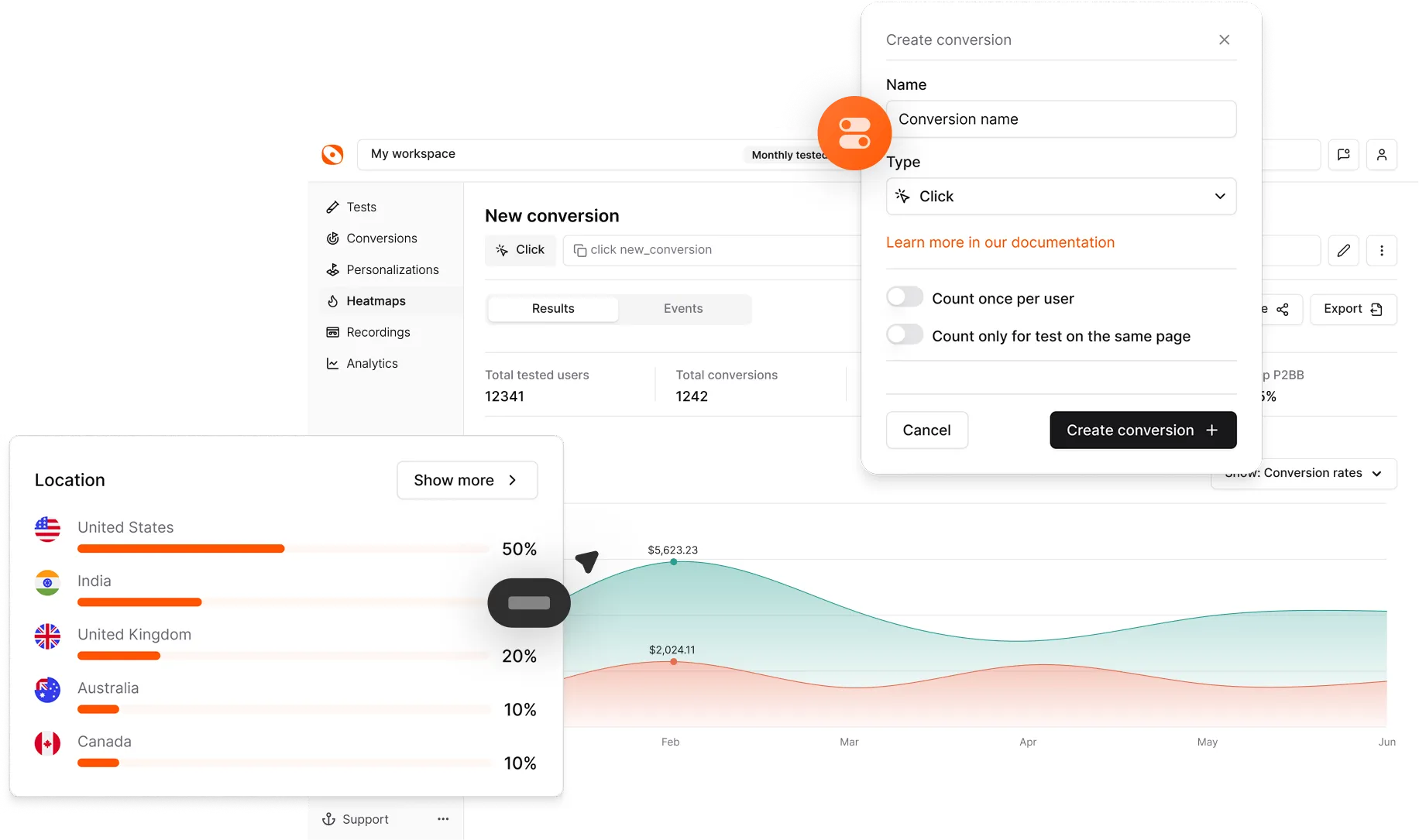
Make decisions backed by data: Understand significance and P2BB.
Teams run random experiments without clear hypotheses, goals, or prioritization — leading to noise instead of insight.
Stopping tests too early
Declaring winners before statistical confidence leads to false positives and decisions based on incomplete data.
Chasing vanity metrics
Optimizing for clicks instead of revenue or pipeline impact makes experiments look successful — while business results stagnate.
Testing too much at once
Running overlapping or multivariate tests without enough traffic makes results unreliable and impossible to interpret.
Decisions based on gut
Without a structured process, teams default to opinions, hierarchy, or design preference instead of validated evidence.
No iteration process
Even when a test wins, most teams stop there instead of building a repeatable experimentation system.
The solution
A practical experimentation system
This course gives you a structured framework to plan, run, and analyze A B tests with confidence. From hypothesis creation to statistical validation, you will learn how to build a repeatable experimentation workflow.
From idea to valid experiment
Learn how to turn assumptions into clear hypotheses and structured tests that produce statistically reliable results.
Know when to trust results
Understand sample size, test duration, confidence levels, and how to interpret Probability to Be Best correctly.
Build a repeatable testing engine
Create a scalable workflow your team can use continuously, instead of running isolated tests with no structure.
"Literally in the span of about two months of A/B testing, we have raised our tracked conversion rate from around low 6 percent to low 8 percent"
Julian Galluzzo
Community projects @ Memberstack
"Our landing page conversion rate increased from 3.9% to 5.4% after running the A/B test, which helped us get more value from our Google Ads"
Helen Lu
Marketing Coordinator @ PheedLoop
"It’s the easiest way for marketers to make a difference to your conversions… being able to quickly test any small variation has such a big impact."
Corey Haines
CEO @ Conversion Factory
Why learn from us
Built by teams who run tests daily
This course is not theory. It is based on real experiments run across thousands of websites. We build experimentation software and actively help teams structure, analyze, and scale their testing programs.
Used by 3,000+ teams
Optibase powers experiments for companies like SurferSEO, Memberstack, and UpGuard across different industries.
We advise teams on real tests
We regularly help marketing teams design hypotheses, interpret results, and avoid costly mistakes in live production environments.
Built by CRO practitioners
Created by the team behind Flowout, an agency working with Stripe, Kajabi, and ActiveCampaign on CRO strategy.
Course curriculum
What you will learn
Module 1
What A/B testing really is
Understand A/B, split, and multivariate testing, when to use each, and why even experienced marketers are often wrong without data.
Module 2
What you should actually test
Learn what moves conversions: headlines, layouts, navigation, forms, CTAs, social proof, and content depth. Prioritize what impacts revenue first.
Module 3
From research to hypothesis
Turn analytics and user behavior into structured hypotheses. Stop random testing and start running experiments tied to real business goals.
Module 4
Running tests without ruining data
Learn sample size, test duration, traffic requirements, and how to avoid overlapping experiments that destroy statistical validity.
Module 5
Reading results with confidence
Learn how to interpret statistical significance, confidence levels, and P2BB so you know when a winner is real and when results are just noise.
Module 6
Avoid costly testing mistakes
Common A/B testing errors that waste time and revenue. Learn how to iterate properly and build a repeatable experimentation engine.
Whether you’re scaling paid acquisition, optimizing landing pages, or improving demo conversions, this course gives you the structure to introduce experimentation without disrupting performance.
You’re responsible for pipeline and revenue, but experiments feel ad hoc and inconsistent. You need a repeatable testing system that proves impact, not scattered ideas that are hard to defend internally.
Marketing leaders scaling teams
You want experimentation to become part of your team’s workflow, not a side project. This course helps you introduce structure, align stakeholders, and build a culture of data-driven decisions.
Performance marketers scaling spend
You’re investing in paid traffic and need landing pages that convert consistently. Learn how to validate changes before scaling budget and reduce risk when optimizing high-impact funnels.
PMMs optimizing messaging
You test positioning, messaging, and launches but lack statistical clarity. This course shows how to structure experiments, measure properly, and move from opinions to confident rollout decisions.
FAQ
Frequently asked questions
What is A/B testing and why is it important?
A/B testing is a method of comparing two versions of a webpage or element to see which performs better based on real user behavior. Visitors are randomly shown different variations, and results are measured against a defined goal like signups or revenue. It is important because it replaces opinions with data, reduces risk, and helps marketing teams improve conversions without increasing traffic spend.
How long does it take to complete the course?
The course includes six focused video modules and can be completed in a few hours. Most teams go through it in one or two sessions. Each lesson is designed to be practical and concise, so you can quickly understand the framework and start applying structured A/B testing to your own website without weeks of training.
Do I need a developer to run A/B tests?
Not necessarily. Many modern A/B testing tools allow marketers to create and launch experiments without writing code. The key is having a clear hypothesis, defined conversion goals, and enough traffic for valid results. In some complex cases developer support can help, but most marketing experiments can be run independently.
What is the difference between A/B testing and Split testing?
A/B testing compares small changes on the same page, such as a headline, button, or layout element. Split testing, often called URL split testing, compares two completely different pages by sending traffic to separate URLs. A/B tests are ideal for incremental improvements, while split tests are better for testing larger design or structural changes.
Is this A/B testing course really free?
Yes. The course is completely free to access. We created it to help marketing teams introduce structured experimentation without financial barriers. You simply sign up to unlock the lessons. There are no hidden fees or upsells. While we build experimentation software, the course itself is educational and can be applied using any A/B testing tool.
Do I need Optibase to take this A/B testing course?
No. The course is tool agnostic and focuses on principles that apply to any A/B testing platform. You can follow along using whatever tool your team already uses. We reference Optibase in examples because we built it, but the framework, decision models, and statistical guidance work regardless of software.
How do I choose the right A/B testing tool for my business?
Choose a tool that fits your traffic, team size, and workflow. Look for clear reporting, statistical confidence metrics, easy setup, and minimal performance impact. Avoid platforms that require heavy implementation or complex onboarding if you are just starting. The best tool is one your team can use consistently without friction.
Is A/B testing safe for SEO?
Yes, A/B testing is safe for SEO when implemented correctly. Search engines allow experiments as long as you do not cloak content or use permanent redirects for temporary tests. Most modern testing tools follow best practices automatically. Keep tests temporary, use proper redirect types, and implement the winning version once the experiment ends to avoid SEO issues.